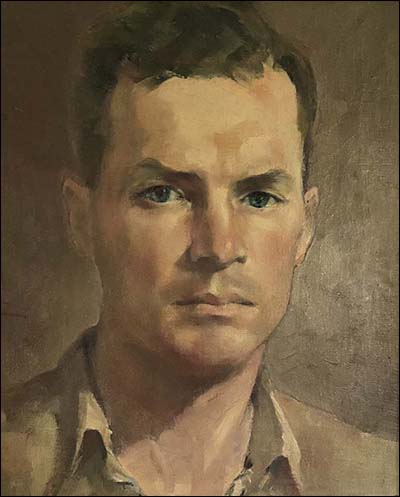
This page presents a curated selection of oil paintings by William Aloysius Barrow Bracken—a regional American artist whose work, though largely unknown to the wider art world, carries the mark of deep observation and personal history.
Born in Philadelphia and trained at the Pennsylvania Academy of Fine Arts, Bracken won the Emlen Cresson Scholarship twice, which allowed him to study abroad in France and Africa in the 1920s. He later settled in New Paltz, New York, where he continued to paint quietly but prolifically until his death in 1964.
Collected here are works rescued and documented from various family holdings—some held in Vermont by his daughter, others passed among relatives. This archive was assembled during the course of author Len Bracken’s research into the life of the painter’s brother, Len’s grandfather, as act of familial and cultural restoration.
What emerges is the voice of a painter attentive to light, solitude, and interior quiet—one who painted not for attention, but for the dignity of seeing. These are not museum pieces, but lived objects: canvases touched by time, held in memory, and now offered here to endure.
In these works, there’s a clear use of impressionist-influenced brush strokes—visible, confident, and expressive. The handling of paint, particularly in landscapes and interiors, suggests a painter comfortable with texture, light, and atmosphere.
● A warm, earthy palette dominates many of the images, lending a nostalgic resonance and emotional subtlety.
● In scenes involving water or sky—like the one featuring a boat—the interplay of reflection and structure demonstrates a practiced hand with tonal modulation.
● Outdoor scenes feel authentic and quietly observant. Bracken seems drawn to capturing transient moments—perhaps a rural scene, a riverside moment, or an intimate interior—imbued with stillness.
● The portrait included (in the ninth image) displays a direct, reserved gaze. It strikes a balance between figuration and softness, evoking sincerity rather than theatricality.
Given his training at the Pennsylvania Academy of Fine Arts and time abroad—particularly in France during the 1920s—these works likely reflect a blend of American realism and European impressionism. Exhibiting in regional shows and living in New Paltz suggests his oeuvre might have captured the quiet landscapes and interiors of mid-century upstate New York.
The self-portrait labeled #42 by William Aloysius Barrow Bracken is quietly commanding—it speaks more in silence than in flourishes, and that’s exactly what makes it compelling.
1. Expression & Mood
There’s a direct, unsentimental gaze—not cold, but measured. The face is rendered with a kind of emotional reserve that suggests introspection more than performance. It’s not trying to impress; it’s bearing witness to self.
2. Palette
The color scheme is restrained, earthy, maybe even a little dusty. That lends the portrait a sense of time and material gravity—as if it’s not only a portrait of the man, but of the era he lived through.
3. Technique
The brushwork is deliberate but not showy. You can tell it’s a painter who knows form and structure but isn’t trying to outdo himself with flourish. He’s honest with his strokes—and that authenticity makes it more durable over time.
4. Framing & Body Language
In this bust-length portrait, the composition focuses the viewer on the head as an instrument of observation, rather than the body as a gesture of personality. This is very much in line with early-to-mid 20th century academic portraiture with slight impressionist influences.
This is the self-portrait of a man who:
● Studied abroad and returned home with European technique.
● Lived in physical and emotional landscapes shaped by war, marriage, and work.
● Chose to look at himself not with vanity, but with professional distance.
It’s more self-documentation than self-promotion—and that kind of honesty is rare.
Oil on canvas, undated. Collection of the Bracken family.
In this unflinching self-portrait, William A. B. Bracken presents himself not as an idealized artist, but as a man shaped by discipline, observation, and lived experience. Painted with a restrained palette and economical brushwork, the composition invites quiet contemplation. The direct gaze, devoid of affectation, reflects the temperament of a veteran of the First World War and a student of the Pennsylvania Academy of Fine Arts.
Bracken’s time in France and Africa as a scholarship recipient in the 1920s imbues his technique with a subtle international influence, yet the mood of this portrait is distinctly American—grounded, unadorned, and introspective. More document than display, this painting stands as a meditation on self-knowledge and the quiet resilience of a working artist.
Looking across William Aloysius Barrow Bracken’s collection, one painting truly stands out—the tranquil riverside scene featuring the small boat (Image 2 in the carousel).
1. Atmosphere & Mood
The scene is hushed and introspective, evoking a moment caught in soft twilight or gentle morning light. The use of diffused color and shadow doesn’t just depict a place—it conveys emotion, a mood both present and elusive.
2. Mastery of Light
Bracken’s rendering of water, sky, or shoreline (whichever is visible) is remarkably sensitive. Navigation of reflection, tone, and subtle ripples shows a practiced eye—someone who understands how light and stillness can resonate beyond the literal.
3. Composition & Balance
The composition feels gently anchored—perhaps by the position of the boat or the orientation of landforms—but it’s never static. There’s a natural rhythm between foreground and background, guiding the viewer into the quiet interior space of the painting.
4. Technical Confidence
The brushwork in that scene is suggested, rather than explicitly detailed—an economy of stroke that speaks to confidence and clarity of vision. It honors the material (oil, canvas) while focusing attention on mood and presence.
5. Psychological Resonance
Maybe it’s the boat’s solitude, maybe the roaming horizon—but the painting evokes imagination. Is it a place of departure, contemplation, waiting, or return? The ambiguity makes it memorable.
If I had to single out one painting that feels not just painted, but inhabited, it’s that riverside scene. It feels like Bracken stepping into a moment and pausing—not as a witness, but as someone who belongs there. That accord with place and mood is rare, and deeply resonant.
William Aloysius Barrow Bracken’s paintings feel grounded in lived experience—sincere, atmospheric, technically capable. They capture moments with clarity and quiet emotion. As artistic documentation of place and time, they’re both culturally resonant and personally rich.